Simple EKET IKEA Cabinet File Organizer
Paper clutter made me build furniture
I was running out of desk space and I was starting to just haphazardly stacking my important papers.
I didn't want a desk organizer eating surface area, so I built a file organizer that slides inside an IKEA EKET cube, leaves space on top, and acts like a simple IN / OUT system. I wanted something simple and on which I could start flexing any DIY "woodworking" muscles (that I barely have).
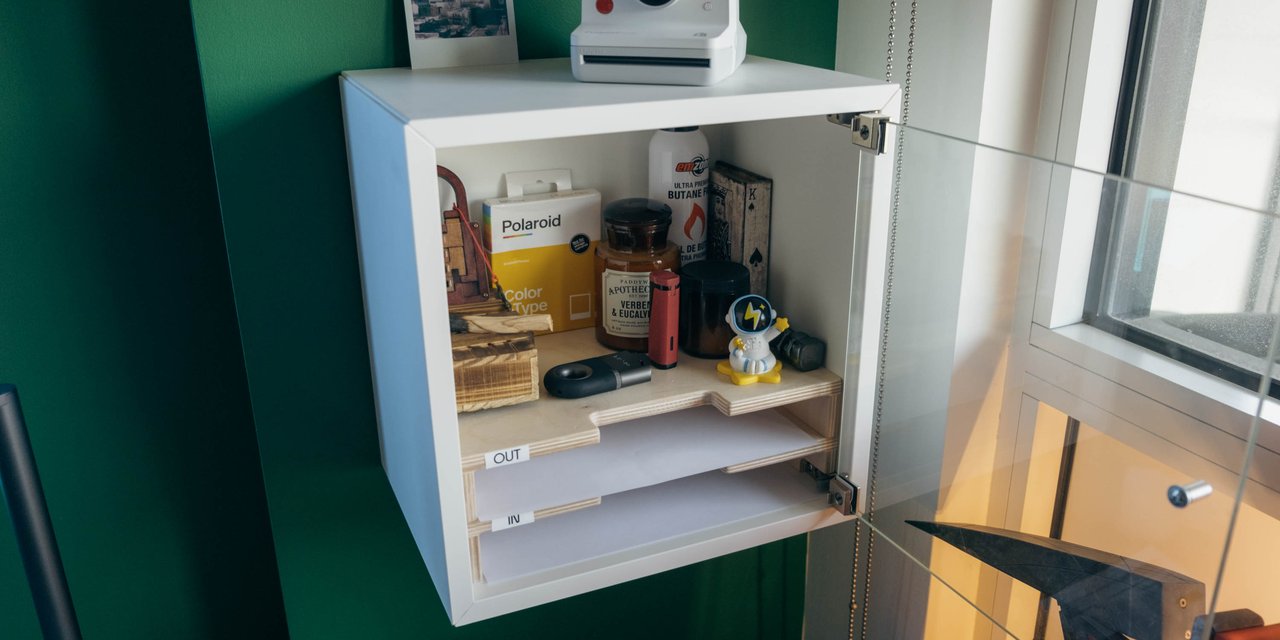
Simple EKET IKEA Cabinet File Organizer
The part I refused to learn the hard way
I knew I could design this BUT I was less confident in the execution.
So I designed a quick 3D prototype first to understand how it would look like (file at the end). When I was happy with the direction, I went to Les Affûtés (opens in new tab) so I can build it with professional help, while relying on my design prototype.
The cool thing was that we could roughly rely on the dimensions of the 3D sketch, and could easily communicate the look and feel.
I realize only now that I also did the most important move of this whole project: I brought the actual EKET cabinet with me. Yes, IKEA publishes measurements and I could have simply brought those and the sketch. The reality is that inserts live and die by a few millimeters.
It allowed me to kill an entire category of failures:
- “Wait, the inside is slightly different than the spec”
- “Whoops, that corner isn’t perfectly square”
- “Cool, the finish added thickness and now it binds”
If you’re new to woodworking (hi), this is how you keep it fun (at least, that's how I did it).
The great thing at Les Affûtés I did all the work but with the help of a master craftsman. I could focus on the maker part and let the wood expert handle the woodworking expertise to guide me. And it's cheap too!
The 3D Model
I modeled the organizer in 3D so I could answer obvious questions quickly:
- does it feel cramped?
- do my fingers have room?
- does it look good inside the cube?
I used Shapr3D on iPad because I didn’t have a laptop at the time (only a workstation) and I wanted something I could iterate on anywhere (and wanted to try something new).
Stuff that tried to ruin this (so you don’t repeat it)
- Perfect fit is a trap. Inserts should slide in easily, not “fit like a glove.”
- Finish changes dimensions. Tiny changes matter if you design too tight.
- Finger clearance is everything. If it’s annoying to grab papers, you won’t use it.
Some stuff to keep in mind
- Measure your actual cabinet, even if the internet gives you a spec sheet.
- Design for tolerance, not perfection. Give it breathing room.
- Bring the target object (the cabinet) to the shop/makerspace.
- Keep the system dumb-simple: IN and OUT beats five categories you won’t maintain.
- Optimize for daily friction, not aesthetics. Pretty is good. Easy-to-use is permanent.
Project files
You can download the Shapr3D model here. You are free to use it under the GNU GPLv3 (opens in new tab) license.
Now go make something!